ORIENTALISM AND THE OTHERING OF KASHMIRIS: A POSTCOLONIAL ANALYSIS OF HUMAN RIGHTS VIOLATIONS IN INDIAN-ADMINISTERED KASHMIR
ORIENTALISM AND THE OTHERING OF KASHMIRIS: A POSTCOLONIAL ANALYSIS OF HUMAN RIGHTS VIOLATIONS IN INDIAN-ADMINISTERED KASHMIR

RESEARCHER: JABIR AHMAD
Abstract:
The conflict in Jammu and Kashmir has predominantly been analyzed through geopolitical and security-centric paradigms. This article argues that these frameworks are insufficient for understanding the persistence and normalization of human rights violations in Indian-administered Kashmir (IAK). It posits that the systemic repression must be understood through the lens of postcolonial theory, specifically Edward Said’s concept of Orientalism. The research demonstrates how the Indian state and its supportive media apparatus engage in a process of "othering" that discursively constructs Kashmiri Muslims as irrational, violent, and perpetually "other."
This Orientalist discourse serves to legitimize exceptional legal regimes, militarization, and human rights abuses by framing them as necessary measures within a civilizing or counterterrorism mission. Methodologically, this qualitative study employs critical discourse analysis to examine state narratives, legal frameworks like the Armed Forces Special Powers Act (AFSPA), media portrayals, and reports from international human rights organizations.
The findings reveal that othering is not a peripheral byproduct
but a central mechanism enabling violence. It embeds itself in law (legal
othering), culture (cultural othering), and everyday media practices (everyday
othering), creating a paradigm where Kashmiri political dissent is pathologized
and their voices are systematically silenced. The article concludes that a
lasting resolution to the Kashmir conflict requires a fundamental dismantling
of these Orientalist narratives and a recognition of Kashmiri agency, proposing
several innovative, human-security-focused measures for peacebuilding.
Keywords: Kashmir, Orientalism, Othering, Postcolonial Theory, Human Rights, AFSPA, Securitization, Edward Said.
INTRODUCTION:
The unresolved conflict in Jammu and Kashmir remains one of the most enduring and destabilizing disputes in South Asia. Emerging from the traumatic partition of the Indian subcontinent in 1947, the region has been the site of three wars, a persistent insurgency, and a debilitating cycle of violence that has claimed tens of thousands of lives. While the interstate rivalry between India and Pakistan forms a critical dimension of this conflict, an exclusive focus on geopolitics often obscures its profound human cost and internal dynamics.
Within
Indian-administered Kashmir (IAK), millions of civilians live under conditions
of intense militarization, legal exceptionalism, and systemic restrictions on
fundamental freedoms. Reports by the Office of the UN High Commissioner for
Human Rights (OHCHR) in 2018 and 2019 documented widespread violations,
including arbitrary detention, excessive use of force, torture, and enforced
disappearances[1].
Amnesty International’s 2019 report detailed the devastating impact of
pellet-firing shotguns, which have blinded or maimed thousands of civilians,
particularly youth[2].The
Indian state justifies these practices through a discourse of counterterrorism
and national security integrity. However, for the Kashmiri people, these
measures translate into a daily reality of fear, trauma, and political
disenfranchisement.
The economic repercussions are equally
severe. Prolonged conflict has devastated the local economy, stifling
investment, disrupting trade, and destroying the vital tourism sector. The
communication blackouts, most notably the unprecedented 213-day internet
shutdown following the abrogation of Article 370 in August 2019, crippled
education, healthcare, and commerce[3].
This economic paralysis is not incidental but a form of systemic disempowerment
that reinforces political control.
This study contends that conventional
frameworks of international relations and security studies are inadequate for
fully comprehending the depth and persistence of this repression. Instead, it
turns to postcolonial theory, particularly Edward Said’s seminal work on
Orientalism, to argue that the violence in Kashmir is enabled and sustained by
a pervasive discourse of "othering." The Indian state and mainstream
media frequently construct Kashmiri Muslims as violent, irrational,
untrustworthy, and manipulated by external forces a modern-day
"orient" within. This discursive construction draws on colonial
logics of the civilizing mission, legitimizing militarization and the
suspension of democratic norms as necessary for managing a population portrayed
as inherently disruptive.
This article will explore how this
process of othering functions across legal, cultural, and media domains to
normalize human rights violations. By applying the theoretical lenses of Said,
Homi Bhabha, and Gayatri Spivak, this research aims to bridge a significant gap
in the literature, which has often overlooked the role of discursive power in
sustaining the Kashmir conflict. It seeks to reframe the issue from a purely
territorial dispute to a profound humanitarian and epistemological crisis,
where the right to define reality and one’s own identity is the ultimate
contested ground.
THEORETICAL FRAMEWORK AND
METHODOLOGY:
This research is grounded in
postcolonial theory, which provides the tools to deconstruct the power
relations, representations, and discourses that sustain neocolonial structures
of domination within ostensibly postcolonial nations.
'
Theoretical
Framework:
The primary theoretical lens is Edward Said’s
Orientalism (1978). Said argued that the West produced a discourse about the
"Orient" (the East) as its inferior other irrational, degenerate,
stagnant, and threatening. This discourse was not merely descriptive but
constitutive, providing the justification for colonial domination and
management. This article adapts this framework, arguing that the Indian state,
particularly under the influence of majoritarian Hindu nationalism, constructs
Kashmir and its Muslim majority population through a similar Orientalist lens.
Kashmiris are portrayed as a people incapable of self-governance, inherently
seditious, and in need of integration and control by the Indian state a classic
"civilizing mission" trope.
This is supplemented by Homi Bhabha’s
concepts of stereotyping and ambivalence (1994). Bhabha contends that colonial
discourse is ambivalent, simultaneously portraying the colonized as savage
(requiring discipline) and childlike (requiring nurture). In the Kashmiri
context, this manifests in the dual portrayal of Kashmiris as dangerous
"terrorists" to be crushed and as innocent, simple folk whose
"paradise" has been ruined by external militants a narrative often
used in official tourism propaganda.
Finally, Gayatri Spivak’s seminal essay,
"Can the Subaltern Speak?" (1988), is crucial. Spivak examines how
the most marginalized subjects (the subaltern) are silenced by the overlapping
discourses of colonialism and patriarchy. Their resistance is either co-opted
or re inscribed within the dominant narrative. In Kashmir, the authentic
political voices of Kashmiris are consistently spoken for, erased, or re-framed
as terrorism by the state, security experts, and often, the national media.
Methodology:
This study follows a qualitative
research approach that focuses on Critical Discourse Analysis (CDA). CDA
examines how text and speech in social and political contexts contribute to the
creation, maintenance, and resistance of social power imbalances, dominance,
and inequality. The analysis is based on three major types of sources:
1.State
Narratives: These include official statements from
the Ministry of Home Affairs and Defence, parliamentary discussions, and legal
documents such as the Armed Forces Special Powers Act (AFSPA).
2.Media
Portrayals:This involves op-eds, news articles, and
prime-time debates from prominent Indian media outlets that influence public
perception.
3.Human Rights
Reports: These are reports from international
organizations such as the Office of the United Nations High Commissioner for
Human Rights (OHCHR) and Amnesty International, which offer alternative
viewpoints and document human rights violations.
By examining these texts, the research
will identify recurring themes, ways of framing issues, and linguistic methods
that support the process of othering and show how this discourse supports the
justification of violence.
OTHERING
AND THE JUSTIFICATION OF HUMAN RIGHTS VIOLATIONS:
The process of othering is a way of
speech and writing that allows a dominant group to define a subordinate group
as fundamentally different and less valuable thereby justifying different, often
violent treatment.
In the context of Kashmir this occurs through
three related channels: legal, cultural, and everyday media discourse.
Legal
Othering:
The State of Exception The use of harsh laws
like the Armed Forces Special Powers Act (AFSPA) and the Public Safety Act
(PSA) is a form of legal othering.
AFSPA, in effect since 1990, gives security
forces broad powers to use deadly force, make arrests without warrants, and
enter and search any place without a reason. Most importantly, it allows these
forces to be protected from legal consequences, as a central government
approval is needed for prosecution, and that approval is rarely given.
This situation creates what political philosopher Giorgio Agamben describes as a "state of exception," where the law is not fully in effect in the name of maintaining law and order. Kashmir is turned from a space where people have rights into a place where security is the main concern, and the lives of Kashmiris are considered “bare life” lives that can be used for violence without being treated as a legal or political issue. The law itself becomes a tool for othering, formally placing Kashmiris outside the protection of the Indian Constitution, reducing their humanity legally to make it easier to use unaccountable force[4].
Cultural Othering:
The Civilizing Mission Cultural othering
undermines the political ambitions of Kashmiris by presenting them as lacking
in culture.
The demand for freedom or self-determination
is rarely considered on its own merits. Instead, it is often labeled as
“terrorism,” “separatism,” or “Pakistan-sponsored jihad.” This denies the
political nature of the Kashmiri resistance, attributing it to a foreign,
harmful force that influences a passive population.
This
narrative closely resembles the colonial civilizing mission:
The Indian state sees itself as a modern,
democratic force that is bringing a backward, rebellious region into the
national mainstream. The removal of Article 370 in 2019 was framed as a step
towards “development” and “complete integration,” a narrative that implies that
the previous special status of Kashmir was a sign of its backwardness and the
need for it to be “saved” by the Indian state[5].
This cultural othering turns political struggle into a condition that needs
fixing, justifying any action taken to achieve that.
Everyday
Othering:
Media and Demonization Mainstream Indian media plays a key role in the everyday reproduction of Orientalist stereotypes.
The way events are presented follows a
predictable pattern:
Protesters are called “terrorists” or “anti-nationals”:
Young people throwing stones are not shown as political protesters carrying out
resistance, but as mindless, violent radicals.
Victimhood is reversed: The media often highlights the sacrifices of security forces, portraying them as the real victims, while the suffering of Kashmiris is ignored or justified.
Agency
is denied:Kashmiri women leading resistance
movements, such as the Association of Parents of Disappeared Persons (APDP),
are frequently seen as manipulated by militant groups, with their activism
portrayed as lacking political meaning[6]. This ongoing media discourse helps
dehumanize Kashmiris, making extreme state violence seem acceptable, even
necessary, to the Indian public. It creates a moral framework where the
violation of Kashmiri rights is not seen as a violation, but as a reaction to a
threat that is created by the way they are represented.
APPLYING
POSTCOLONIAL THEORY TO THE KASHMIR CONFLICT:
Postcolonial theory offers a strong way
to understand the power relationships in Kashmir, showing how colonial methods
are still reflected in the actions of a modern postcolonial nation.
Constructing the Internal Other Edward
Said’s work helps us see Kashmir as India’s "internal orient."
Just like the West saw the Orient as inferior
to justify control, the Indian nationalist movement, especially its current
form, sees Kashmiri Muslims as the internal other. They are seen as naturally
disloyal because their Muslim identity makes them suspicious in a country that
increasingly sees being Indian as being Hindu. This idea of being different is
not only political but also deeply rooted in culture and religion, portraying
Kashmiris as a group that must be closely watched and controlled. The effort to
integrate Kashmir is really about making them fit into a single Indian
identity, thus eliminating their unique political identity.
The Savage and the Innocent Homi Bhabha’s idea of ambivalence is clear in the way Kashmiris are shown. On one hand, they are seen as the "savage militant" a dangerous figure that justifies harsh counter-insurgency actions. On the other hand, they are portrayed as the "innocent Kashmiri"a peaceful, beautiful people living in a paradise whose suffering is blamed on terrorism from outside. This second image, while appearing softer, is also disempowering. It takes away Kashmiris’ ability to be active political players, making them helpless victims of forces they can't control. This division allows the state to switch between violence and development, always keeping control over how the conflict is viewed.
Spivak’s
Subaltern:
The Silenced Voice Gayatri Spivak’s question, "Can the subaltern speak?" has a negative answer in the case of Kashmir. The real voices of the Kashmiri people their desires, experiences of violence, and stories of loss are routinely ignored. When they do speak, their words are shaped by others. A call for freedom is seen as "sedition" by the state. A story about abuse is called "Pakistani propaganda" by the media. The international community often talks about Kashmir but rarely gives a platform to the Kashmiri people themselves, instead getting involved in a debate between India and Pakistan. The Kashmiri is thus the ultimate subaltern, with their voices constantly silenced and overridden by more powerful voices.
NATIONAL SECURITY, ORIENTALISM, AND THE
SUPPRESSION OF DISSENT:
The idea of national security is used as a way to justify repression, giving a reason that sounds logical and modern. The Securitization of Dissent According to the Copenhagen School, securitization is when an issue is treated as an existential threat, justifying unusual actions beyond normal politics[7]. In Kashmir, the entire political situation has been treated this way. Political protests, human rights concerns, and even journalism are not seen as democratic rights but as threats to the state.
This shifts the issue from politics, where discussion and agreement are possible, to security, where only force is acceptable. The image of the irrational, dangerous Kashmiri supports this argument and makes it more convincing. The Global "War on Terror" Framework After 9/11, the global counterterrorism movement was eagerly taken up by the Indian state to support their local actions.
By linking the Kashmir conflict to the
"war on terror," India aligns with major Western countries and
presents its local campaigns as part of a larger, acceptable effort. This makes
Kashmiri resistance less credible and limits the ability for their concerns to
be heard internationally. The unique history and politics of Kashmir are lost
in a general, detached idea of "terrorism."
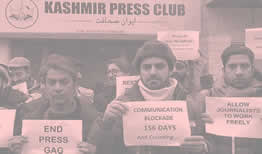
Media Complicity and the Criminalization of Journalism The media in India, with a few exceptions, mostly supports the state's view of the issue. Television channels conduct discussions where Kashmiris are interrupted and their views are seen as unpatriotic. The language is often aggressive and dehumanizing. This media environment not only justifies state actions to the public but also plays a role in silencing Kashmiri voices.
The
arrest of journalists like Fahad Shah, Sajad Gul, and Aasif Sultan under the
Unlawful Activities (Prevention) Act (UAPA) for just doing their job is an
example of how the state uses this to silence those who question it[8].
When journalism itself is labeled as terrorism, there is no space left for
alternative views.
The research analysis shows several
important results:
1.Othering
is Systemic and Structural: The process of
making Kashmiris different is not a random or occasional tactic. It is built
into the governance of Kashmir through laws like the Armed Forces (Special
Powers) Act (AFSPA), in the official stories that deny political freedom, and
in the practices of national media. It is the main idea that supports the
system of control and suppression.
2.Postcolonial
Continuities are Evident: The strategies used by
the Indian state to represent and control Kashmir resemble those of the
colonial period. The idea of a "civilizing mission," the setting up
of a state of emergency, and the silence on native voices are all part of the
old colonial approach, challenging the view that India is fully post-colonial
in its relationship with Kashmir.
3.National
Security Discourse is a Force Multiplier for Repression:
The use of national security ideas, combined with Orientalist views, has made
it impossible for democratic expressions of dissent. It has removed the
difference between a protester and a terrorist, between a journalist and a
separatist, leading to an ongoing emergency situation.
4.The
Human and Economic Cost is a Direct Consequence:
The crisis in Kashmir, both in terms of people and the economy, is not a
byproduct but a direct result of this framework. A people seen as different and
dangerous are considered not worthy of full rights, economic success, or
digital access, as these could encourage their resistance.
These findings suggest a key understanding: The conflict in Kashmir is not just a political issue, but also an issue of how reality is defined. It is a struggle over the right to tell the story, to shape history, and to have one's identity and ambitions recognized as valid. The physical and social impact of this ongoing struggle is evident in the lives of the people of Kashmir.
CONCLUSION AND SIGNIFICANCE OF THE STUDY:
This exploration has argued that the pervasive
and regularized mortal rights violations in Indian- administered Kashmir can
not be completely understood through traditional security or geopolitical
fabrics alone. By applying a postcolonial lens, specifically Edward Said's
conception of Orientalism, it has demonstrated how a deep- seated converse
of" othering" constructs Kashmiri Muslims as an inferior, hanging
internal other. This converse, legislated through law, state policy, and media,
provides the ideological defense for a state of exception, demilitarization,
and the methodical repression of dissent.
The significance of this study is tripartite:
1. Theoretical donation It bridges a
significant gap between Kashmir studies and postcolonial proposition, offering
a new critical frame for assaying the conflict that focuses on power, converse,
and representation.
2. Reframing the Conflict It moves the debate
beyond the binary of India- Pakistan territorial disagreement and centers the
extremity as a profound philanthropic and epistemological issue concerning
agency, voice, and the right to tone- description.
3. Policy Applicability It underscores that
any meaningful movement towards conflict resolution must begin by dismembering
the Orientalist dialogues that fuel it. A military result is inadequate; what's
needed is a digressive shift that recognizes the legality of Kashmiri political
voice.
Proposed Practical results Moving beyond
notice, this exploration proposes several innovative measures concentrated on
mortal security
· Narrative
Transformation Platforms Support and fund independent,cross-border digital
libraries and media platforms run by Kashmiris to amplify their voices
directly, bypassing state- intermediated narratives.
· profitable
Disarmament Advocate for a collective and phased reduction of military
expenditure by India and Pakistan in the region, with finances diverted into
concertedly managed confidence- structure systems( e.g., tourism, environmental
conservation, hydropower).
· Regional Human
Rights Charter Propose a South Asian Duty on the Rights of Conflict- Affected
Populations, establishing minimal philanthropic norms and covering mechanisms,
to which both India and Pakistan would be held responsible.
· Truth and
Reconciliation Commission( TRC) Begin track- II discourses to design a frame
for a future, independent TRC for Kashmir, modeled on South Africa but
acclimated to the South Asian environment, to document abuses from all sides of
the conflict and pave the way for restorative justice.
Eventually, peace in Kashmir will remain
fugitive until Kashmiris are seen not as a problem to be managed but as licit
political agents whose voices must be heard at the negotiating table.
dismembering the O
References
1. Amnesty International. Losing Sight in Kashmir: The Impact of Pellet-Firing Shotguns. London: Amnesty International, 2019.
2. Bhabha, Homi K. The Location of Culture. London: Routledge, 1994.
3. Bhat, Mudasir Ahmad. “Human Rights and Conflict Situation in Jammu and Kashmir.” South Asian Journal of Peacebuilding 5, no. 1 (2017): 45–63.
4. Human Rights Watch. “Everyone Lives in Fear”: Patterns of Impunity in Jammu and Kashmir. New York: HRW, 2006.
5. Jaffrelot, Christophe. Modi’s India: Hindu Nationalism and the Rise of Ethnic Democracy. Princeton: Princeton University Press, 2021.
6. Office of the High Commissioner for Human Rights (OHCHR). Report on the Situation of Human Rights in Kashmir: Developments in the Indian State of Jammu and Kashmir from June 2016 to April 2018. Geneva: United Nations, 2018.
7. Office of the High Commissioner for Human Rights (OHCHR). Update on the Situation of Human Rights in Indian-Administered Kashmir and Pakistan-Administered Kashmir from May 2018 to April 2019. Geneva: United Nations, 2019.
8. Said, Edward W. Orientalism. New York: Pantheon Books, 1978.
9. Schofield, Victoria. Kashmir: The Origins of the Dispute. Oxford: Oxford University Press, 2020.
10. Spivak, Gayatri Chakravorty. “Can the Subaltern Speak?” In Marxism and the Interpretation of Culture, edited by Cary Nelson and Lawrence Grossberg, 271–313. Urbana: University of Illinois Press, 1988.
11. Zia, Ather. Resisting Disappearance: Military Occupation and Women’s Activism in Kashmir. Seattle: University of Washington Press, 2019.
[1] Amnesty International. Losing Sight in Kashmir: The Impact of Pellet-Firing Shotguns. London: Amnesty International, 2019.
[2] Bhabha, Homi K. The Location of Culture. London: Routledge, 1994.
[3] Bhat, Mudasir Ahmad. “Human Rights and Conflict Situation in Jammu and Kashmir.” South Asian Journal of Peacebuilding 5, no. 1 (2017): 45–63.
[4] Human Rights Watch. “Everyone Lives in Fear”: Patterns of Impunity in Jammu and Kashmir. New York: HRW, 2006.
[5] Jaffrelot, Christophe. Modi’s India: Hindu Nationalism and the Rise of Ethnic Democracy. Princeton: Princeton University Press, 2021.
[6] Office of the High Commissioner for Human Rights (OHCHR). Report on the Situation of Human Rights in Kashmir: Developments in the Indian State of Jammu and Kashmir from June 2016 to April 2018. Geneva: United Nations, 2018.
[7] Office of the High Commissioner for Human Rights (OHCHR). Update on the Situation of Human Rights in Indian-Administered Kashmir and Pakistan-Administered Kashmir from May 2018 to April 2019. Geneva: United Nations, 2019.
[8] Human Rights Watch, India: Kashmiri journalist held under abusive laws (New York: Human Rights Watch, February 8,2022)
Related Research Papers